


 By neha - July 08, 2026
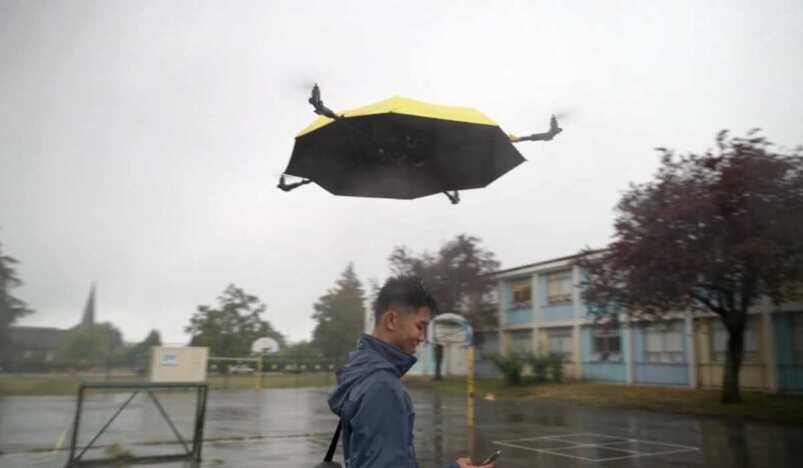
Somewhere between a cartoon gag and genuine engineering breakthrough sits John Tse's latest invention: a fully autonomous flying umbrella that hovers overhead and follows its user hands-free, through rain or shine. What began as a whimsical school-break project has turned into one of the more delightful viral engineering stories of the year.
Who built it
John Tse is a Canadian engineer, filmmaker, and maker known for his YouTube channel, I Build Stuff, where he documents ambitious DIY robotics and engineering projects. The flying umbrella is his most talked-about creation yet, drawing coverage from outlets including Popular Science, New Atlas, My Modern Met, and Designboom, along with widespread attention across X and Instagram.
How the flying umbrella actually works
At its core, the device is a quadcopter drone hidden beneath a standard umbrella canopy. A custom internal frame with folding arms, roughly the size of a tripod when not deployed, forms the central hub, with an actual umbrella, cut away from its original handle, attached on top to conceal the mechanics underneath. Four propellers mounted on a lightweight, 3D-printed frame provide the lift and stability needed to keep the umbrella steady overhead.
The real innovation lies in how it tracks its user. After experimenting with regular cameras and GPS, Tse settled on a time-of-flight depth camera, a sensor that emits light pulses and measures their return time to build a real-time 3D map of its surroundings. Unlike a standard camera, this approach holds up reliably even in low light or heavy rain, allowing the umbrella to follow a person's movement and stay positioned overhead as they walk. For safety, the system hovers several meters above the user at all times.
From a two-week project to a years-long build
The flying umbrella didn't start out as an autonomous system. Tse first introduced a drone-equipped umbrella back in early 2024 as a two-week school-break project, controlled entirely by a handheld remote. That early version proved the basic concept, an umbrella really could fly, but it wasn't practical for everyday use. Undeterred, Tse spent close to a year refining the idea, starting with a smaller test drone before scaling up to the full umbrella frame, eventually incorporating suggestions from his own YouTube audience to push the project toward full autonomy.
Still a prototype, not a product
For now, the flying umbrella remains an experimental build rather than something you can buy. Battery life is limited to roughly 10 to 15 minutes per charge, similar to small consumer drones, and performance can be affected by wind or heavy sideways rain. Tse has been clear that the project isn't intended to replace a conventional umbrella; it's a demonstration of what's possible when accessible drone components, 3D printing, and creative problem-solving come together outside a research lab.
Why it's captured so much attention
Reaction to the flying umbrella has been a mix of genuine excitement and good-natured skepticism. Some see real potential beyond novelty, including possible applications for people with mobility challenges in bad weather, while others view it simply as a clever, fun demonstration of personal robotics. Either way, the project has struck a chord: it takes an idea that feels straight out of a cartoon and makes it, however briefly and imperfectly, real. As Tse himself put it, reflecting on the project's long journey, sometimes progress isn't about making something perfect. It's about making it real.

_20-08-2026_05-08.jpg)
_27-51-2026_11-51.png)
_27-43-2026_12-43.png)



.jpg)
.jpg)




.jpg)


.jpg)
.png)
.jpg)












Leave a comment